Your next sales channel may have no homepage, menu bar, or carefully arranged product categories. It may start inside an AI conversation where someone asks for a relevant product and expects the details to follow.
This raises a practical question for an e-commerce business: how does an AI assistant know what your store can actually sell, deliver, and support?
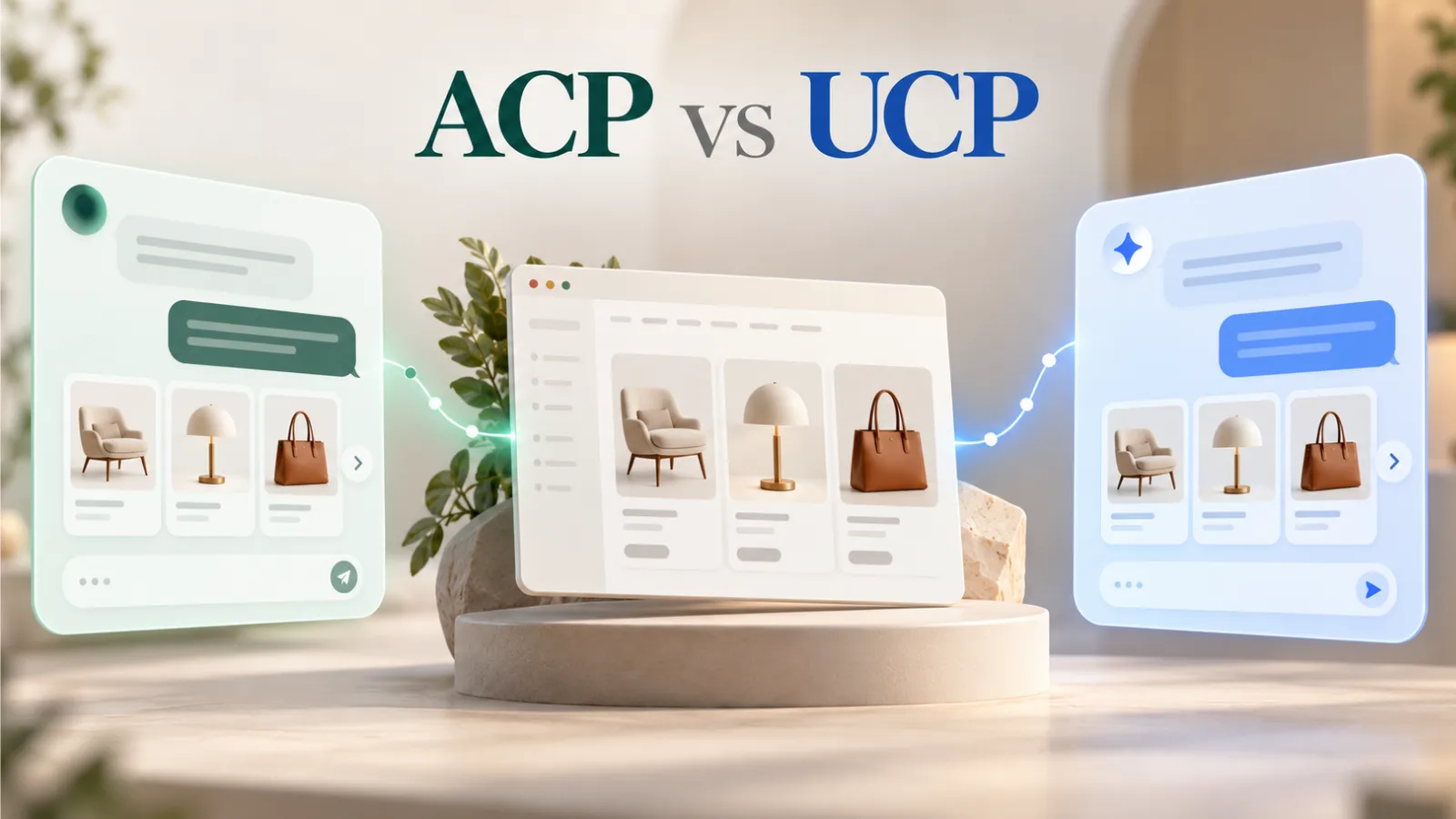
This is where ACP vs UCP becomes significant. Both provide infrastructure for agentic commerce, but understanding them requires looking beyond the promise of faster checkout.
Behind the Conversation
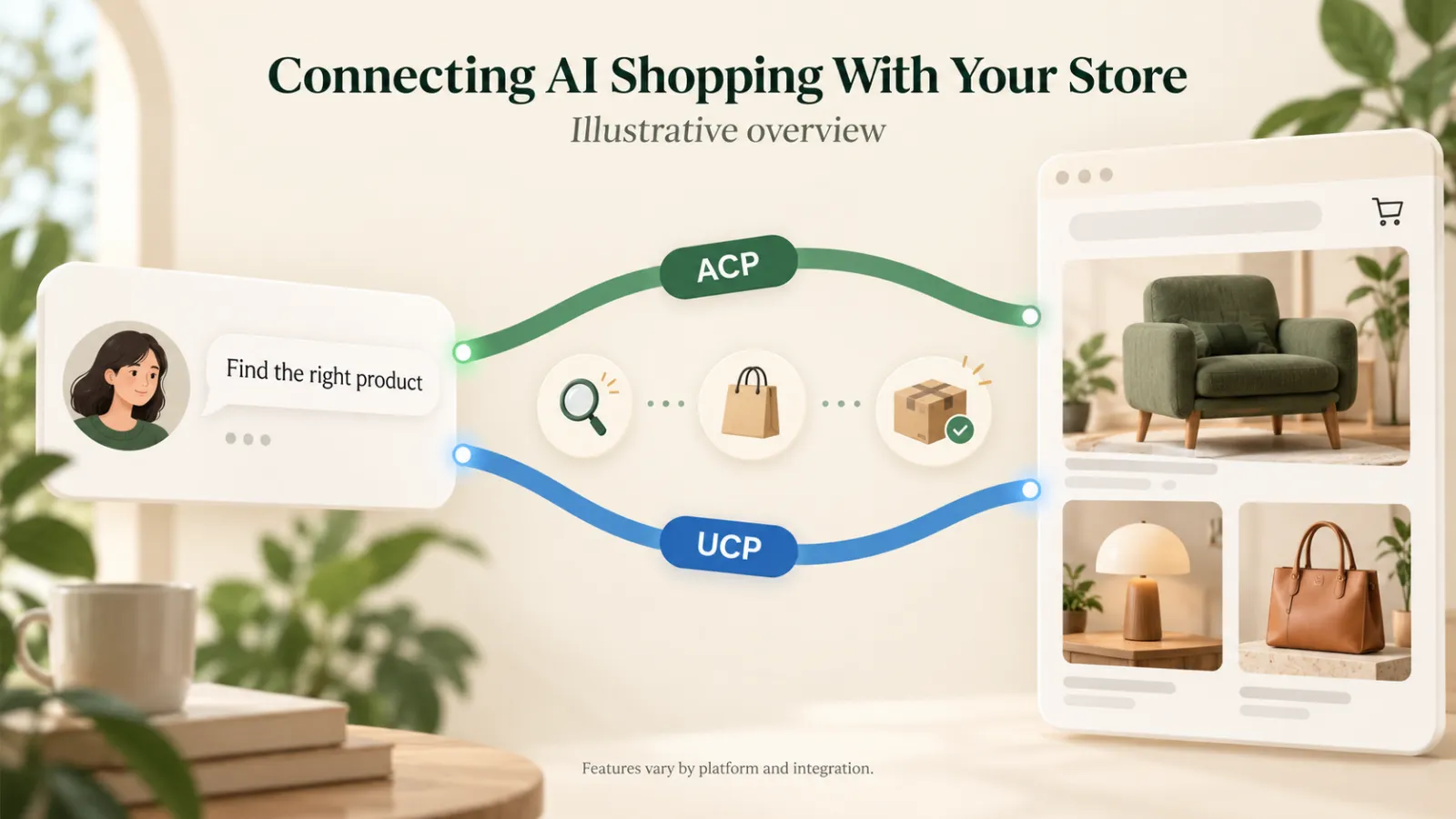
The attention around AI shopping focuses on what customers see: suggestions, comparisons, and familiar answers. Behind those answers, systems must connect AI to the store’s products, inventory, and checkout.
For instance, an assistant might understand that someone needs a dining table for a small apartment. Confirming the selected design, current price, delivery options, and order status requires access to reliable retail systems. Agentic commerce depends on these connections. A protocol provides agreed rules for exchanging information and requesting supported actions.
A useful starting point: ACP vs UCP is the connection each supports, and which one sounds more impressive.
What ACP Does
The Agentic Commerce Protocol (ACP) provides a shared set of rules that helps businesses connect their products and shopping services with ChatGPT.
Its function includes structured product information that helps ChatGPT understand and present a merchant’s catalogue. In the March 2026 update, OpenAI expanded ACP’s role in product discovery. It included richer comparisons and more complete product information. It also said it was prioritizing discovery while allowing merchants to use their own checkout experiences. This matters when discussing ACP vs UCP because ACP should not be reduced to a checkout button inside a chat. OpenAI Developers also documented checkout integrations, with access to Instant Checkout limited to approved partners. Allowing product discovery participation and checkout are separate considerations.
What UCP Does
The Universal Commerce Protocol (UCP) provides an open standard developed by Google with commerce partners including Shopify, Etsy, Target, Walmart, and Wayfair.
In January 2026, an article on the Google Developers Blog introduced it with endorsements from more than 20 ecosystem partners. Its design covers interactions across discovery, purchasing, and order management, giving consumer interfaces, merchants, and payment providers a shared language. The Google Merchant Center mentions that implementation connects eligible merchants with shopping experiences across AI Mode in Search and Gemini. Participation and checkout availability follow platform requirements and phased access.
Where They Differ
ACP vs UCP differ in where they are used and how businesses connect to them. Both aim to support more than checkout.
| Consideration | ACP | UCP |
| Main ecosystem emphasis | Merchant connections with ChatGPT | Commerce interactions across Google AI surfaces and a wider interconnected ecosystem |
| Supported scope | Product discovery and documented checkout integrations | Discovery, checkout, and post-purchase interactions |
| Merchant preparation | Accurate catalogue data and applicable integration requirements | Supported commerce capabilities and Google on-boarding requirements |
| Availability | Depends on the feature and partner access | Depends on phased access and eligibility |
According to OpenAI Developers, ACP vs UCP does not automatically require a brand to choose one permanently. The right connection depends on the platform, customers, market, and supported integrations.
Trust Travels Too
Even after a business achieves a successful technical connection, it can still result in an unsatisfactory purchase. For example, if an assistant shows a table suited for a compact room but misses the space needed around its chairs, the customer would consider this a poor recommendation.
Checkout.com’s August 2026 MENA insights reported that 35% of UAE shoppers said unexpected costs, including delivery fees, would damage their confidence in AI shopping agents. This finding makes transparency relevant to the ACP vs UCP discussion. Clear product detail pages explain suitability and limitations. Recurring customer questions reveal details that connected shopping experiences need.
5 Steps to Prepare Before Integrating
For businesses in Dubai and across the UAE, ACP vs UCP becomes more useful when a few practical checks are met:
- Ask your platform provider: Which discovery and checkout integrations are supported for your business and market?
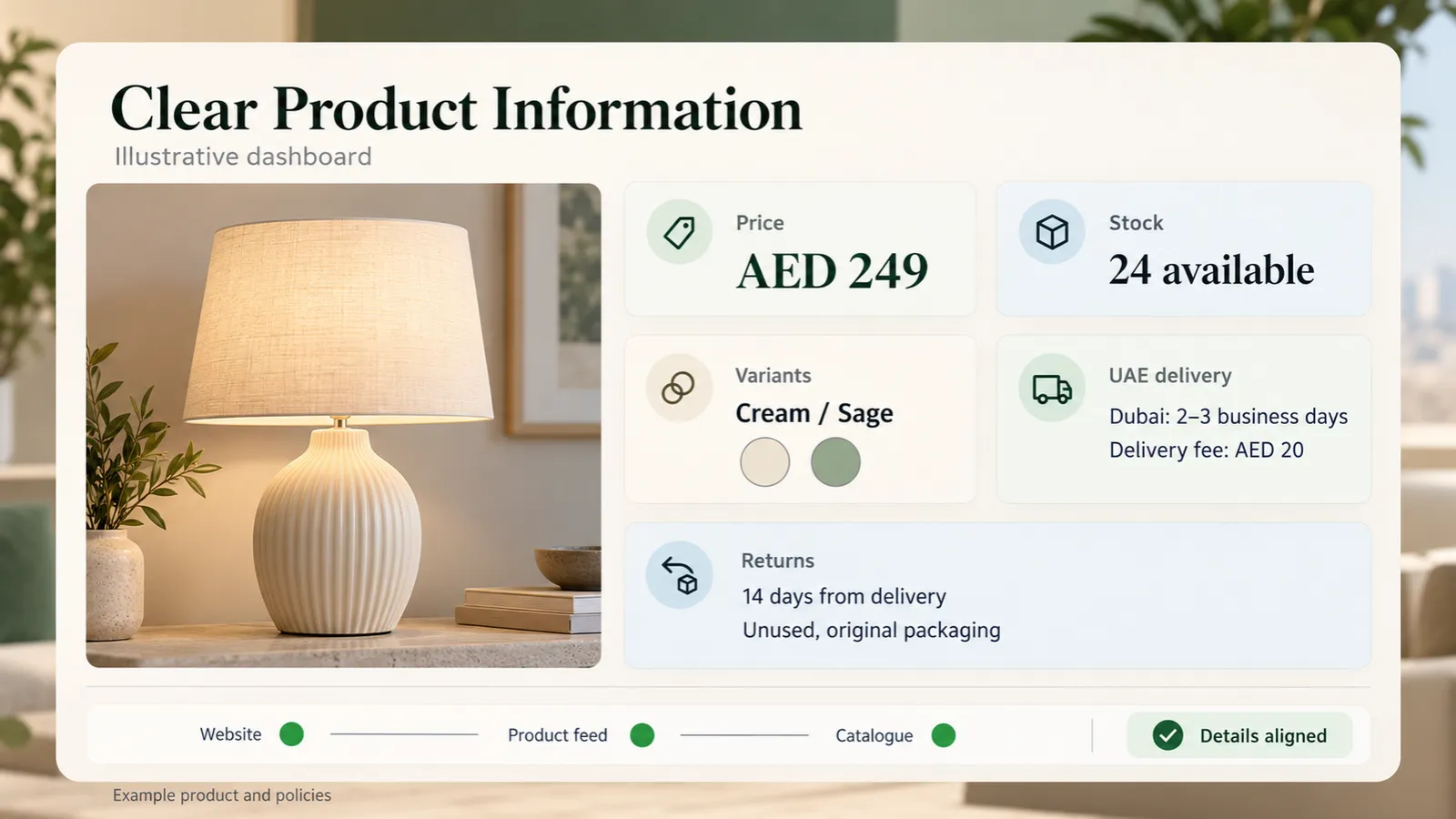
- Arrange your catalogue: Keep identifiers, variants, prices, and availability consistent across systems.
- Write local terms clearly: State delivery areas, charges, installation requirements, and realistic timelines.
- Review product descriptions: Use PDP optimization to clarify fit, compatibility, and exclusions.
- Test the complete experience: Check selection, approval, payment, confirmation, and access to support.
Connecting your store to these systems does not guarantee suggestions or sales. Accurate product information helps AI give customers reliable answers.
A Promise Worth Keeping
The actual question surrounding ACP vs UCP is whether a business can keep the promises AI makes about its products. My work as Suman Shafi begins with making business information clearer through content writing services. Clear information matters even more when customers find your brand through an AI platform.
A shopping journey may become shorter, but businesses still need to deliver what they promise.
Connect With My Writing & Digital Platforms
💼 Connect With Me on LinkedIn
✍️ More on Writing and SEO Insights
📩 Explore My Content Writing Services
⭐ View My Google Business Profile
✍️ About Suman Shafi
Frequently Asked Questions
What does ACP vs UCP mean?
It compares OpenAI’s Agentic Commerce Protocol with the Google-developed Universal Commerce Protocol.
Are ACP and UCP payment gateways?
No. They standardise commerce interactions and can work with payment systems.
Can a brand support both?
Potentially, depending on its platform, resources, and each integration’s requirements.
Does integration guarantee AI visibility?
No. Eligibility and integration do not guarantee product placement or recommendations.
Can UAE merchants use every feature?
Availability varies. Confirm current market eligibility and feature access with the relevant platform.