

A customer asks whether the charger is included. Another wants to know the same. By the third inquiry, its worth asking: what is unclear about the product page? Your team has answered this three times today. Each reply takes a minute, so it’s hardly an issue. But somewhere else, a shopper with the same doubt may have closed the page without asking.
Repeated customer questions reveal the small information gaps that make people hesitate before buying. If businesses treat them as support requests, they miss a chance to improve the product detail page (PDP) information customers rely on before buying.
The Answers Live Elsewhere
A PDP can look complete, but most useful answers live in support inboxes, reviews, and return forms. The team knows what is included, the installation process, and which accessories fit. Customers do not automatically share that knowledge.
Useful product detail pages bring those answers into the buying experience. Before you rewrite yours, look at the customer questions your business already receives.
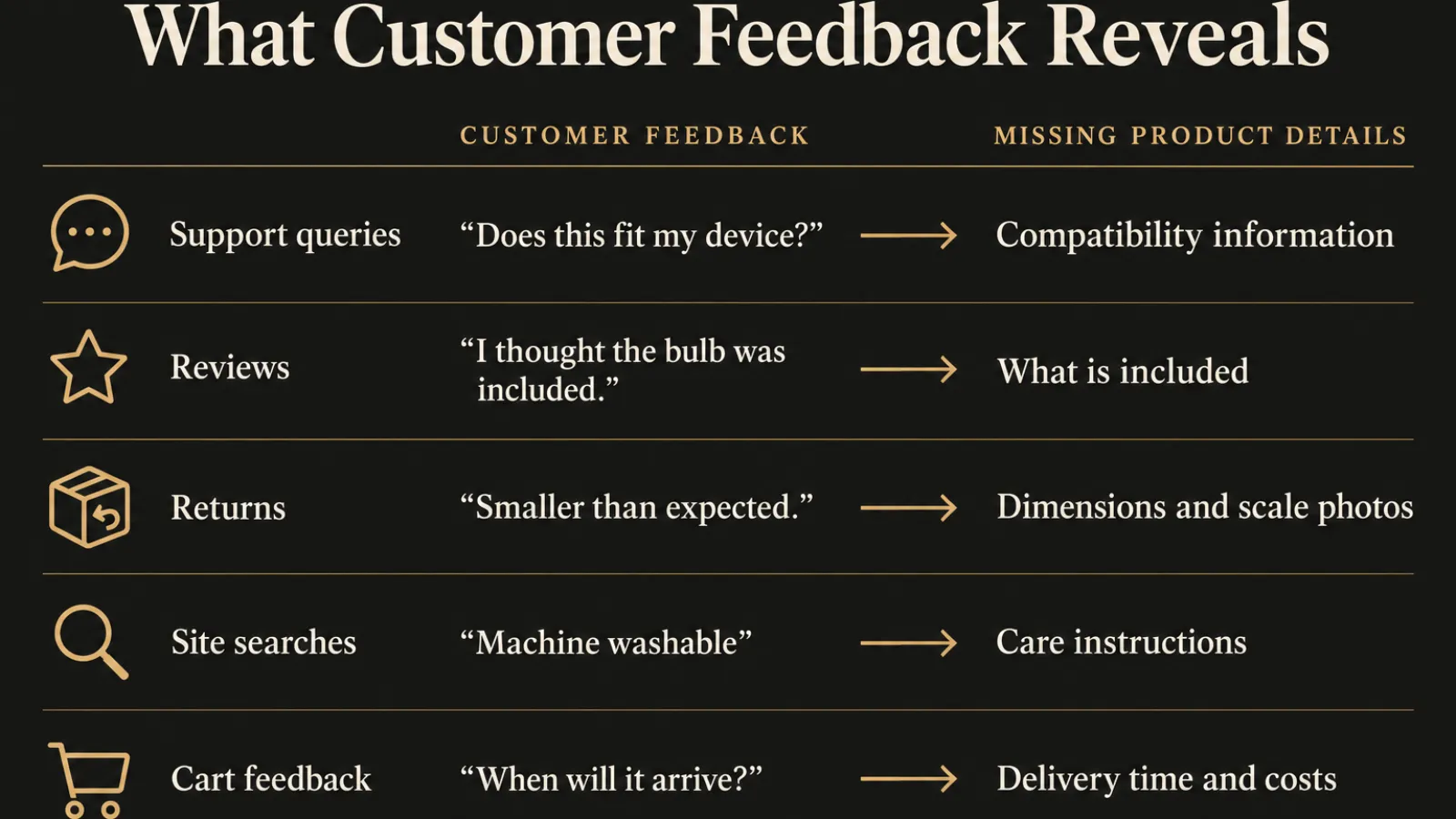
Five Places to Listen
Customer-service queries
These queries indicate immediate uncertainty.
Repeated questions about assembly, compatibility, or materials show missing details, vague wording, or information buried too far down the page. Check where the answer is before assuming you need more copy.
Customer reviews
Reviews expose the difference between expectation and experience.
“Beautiful table light, but I thought the bulb was included” shows missing information about what’s included.
Positive reviews also help: most buyers praise its usefulness for bedtime reading, which may reveal a practical benefit the description has missed.
Return reasons
This shows where expectations went wrong.
“Smaller than expected” could mean marked dimensions and a photo showing scale.
“Difficult to assemble” may justify assembly guidelines and a realistic time estimate.
However, defects and delivery damage require operational fixes. Rewriting cannot repair the product.
Site searches
Site searches capture customers’ own language.
If customers search your website for “replacement filter” or “machine washable”, check whether your product pages clearly explain which filter fits or whether the item can be machine washed.
These clues can inform e-commerce search intent, but a search alone doesn’t mean a PDP failed. Someone may be searching for the right category.
Abandoned-cart feedback
If a customer leaves a cart empty, it indicates their hesitation about delivery, total costs, or returns.
Asking a short, optional question about why they did not complete the purchase can help. If a cart is left empty, it cannot tell you why someone left, and survey replies only represent those who respond.
These sources help you see whether customer questions point to missing information or just a single person’s preference.
Search Needs Specific Answers
These details matter beyond the website.
Google’s guidance, updated in December 2025, explains that AI Mode supports nuanced questions and complex comparisons. It also confirms that established SEO practices remain relevant, with no special optimization required for inclusion in its AI features.
The practical outcome is simple: answering customer questions with the right, accessible text makes the product information more useful for comparison. Compatibility, measurements, and exclusions provide accurate context for AI product recommendation, although clearer content does not guarantee visibility.
Use AI to help group recurring themes if useful, but verify every proposed answer against actual product information.
Doubt Has a Cost
People ask questions because something matters to them.
Someone may ask about a delivery question before buying a farewell gift.
Someone asking a care question might be worried about damaging an expensive purchase.
Baymard’s April 2025 research article on sustainability in e-commerce reported that 60% of sites tested did not offer site- and user-provided product Q&A content. That finding highlights an opportunity to address concerns when people are evaluating a purchase.
For a retailer in Dubai, serving customers across the UAE, customer questions might show uncertainty about delivery coverage or location-specific charges. With clear answers, people might be able to assess better if an order fits their circumstances.
Turn Feedback Into Changes
Start with one regularly purchased product and review a month of feedback. Record repeated customer questions along with their source and the information currently available.
Then make the focused changes:
1. Prioritize significant gaps
Address hesitancy about suitability, safety, and costs first.
2. Choose the right format
Use a scale photograph for size, a table for compatible options, and clear text for exclusions.
3. Place answers near decisions
Keep what is included beside purchase options. Avoid hiding it in a general help page.
4. Check the outcome
Keep track of repeated inquiries, essential return reasons, and conversion changes. Also consider other factors, such as promotions and stock availability.
An FAQ can highlight a customer question, but essential buying information should remain easy to find.

Let Listening Shape the Page
A repeated question is a small invitation to explain something better. Over time, they can guide a page towards the details people actually need.
Through my work at Suman Shafi, I approach SEO content writing with that connection in mind: customer questions should influence what businesses explain.
The next useful edit may already be waiting in an inbox!
I can help turn customer questions into clear, useful product page content through my SEO writing services. Connect with me through my Google Business Profile to discuss what your pages need.
Connect With My Writing & Digital Platforms
✍️ About Suman Shafi
📩 Explore My Content Writing Services
✍️ More on Writing and SEO Insights
⭐ View My Google Business Profile
💼 Connect With Me on LinkedIn
📸 Follow @suman.reflects on Instagram
📝 Read My Writings on Medium
Frequently Asked Questions
Which customer questions should I prioritise?
Start with repeated concerns that affect suitability, safety, compatibility or the total purchase cost.
Should every support query become an FAQ?
No. Put essential details directly on the page; reserve FAQs for additional clarification.
Can return feedback improve product descriptions?
Yes, when it exposes an expectation gap. Product faults require a separate operational response.
What can site searches reveal?
They show customers’ vocabulary and needs, which may expose content, navigation or assortment gaps.
How do I know an update helped?
Compare relevant enquiries, returns and conversions before and after, allowing for other business changes.