
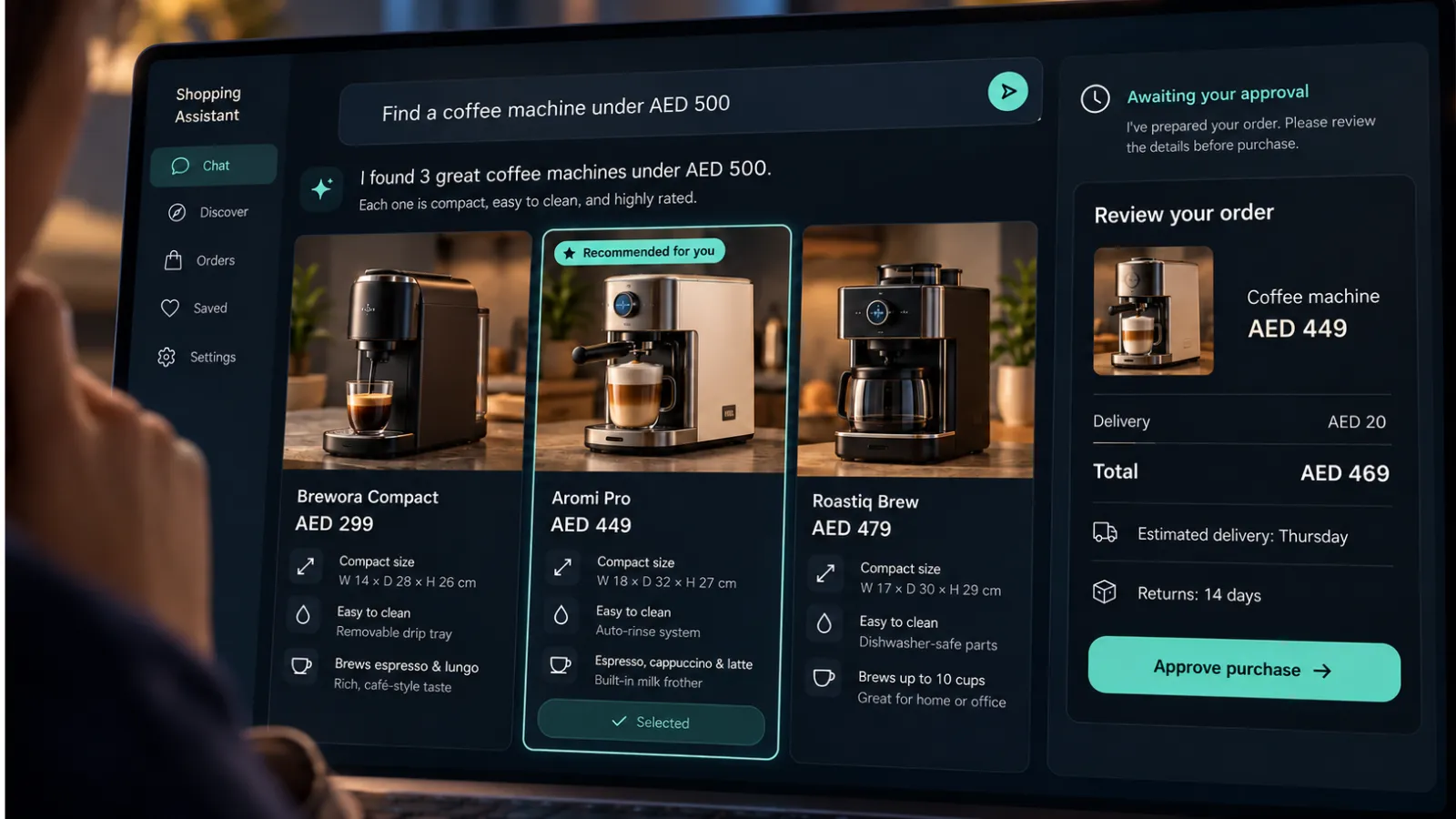
Requesting someone who knows you well might sound something like this:
“Find a coffee machine under AED 500 that is suitable to my kitchen, easy to maintain, and can arrive before Saturday.” This also shows how shopping can start with an AI assistant, describing the situation, budget, and deadline rather than a product name.
As business challenges grow, a product must be easy to discover, compare, and purchase through a journey they may only partly control. Agentic commerce brings those stages closer together, letting AI help carry a shopper’s request towards action.
Beyond the Recommendation
Agentic commerce refers to shopping in which an AI agent acts on a customer’s behalf, within agreed permissions. Depending on the system, it may compare products, check availability, prepare the final cart, or help completing a purchase.
The difference between AI product recommendation and agentic commerce is what happens after the suggestion.
A recommendation says: “This coffee machine is best for you.”
An AI agent goes further: checks availability, prepares the order, or helps you purchase with your approval.
Reliable AI product recommendations remain the starting point. Agentic commerce adds the possibility of acting on them. However, capabilities differ across platforms, merchants, and countries.
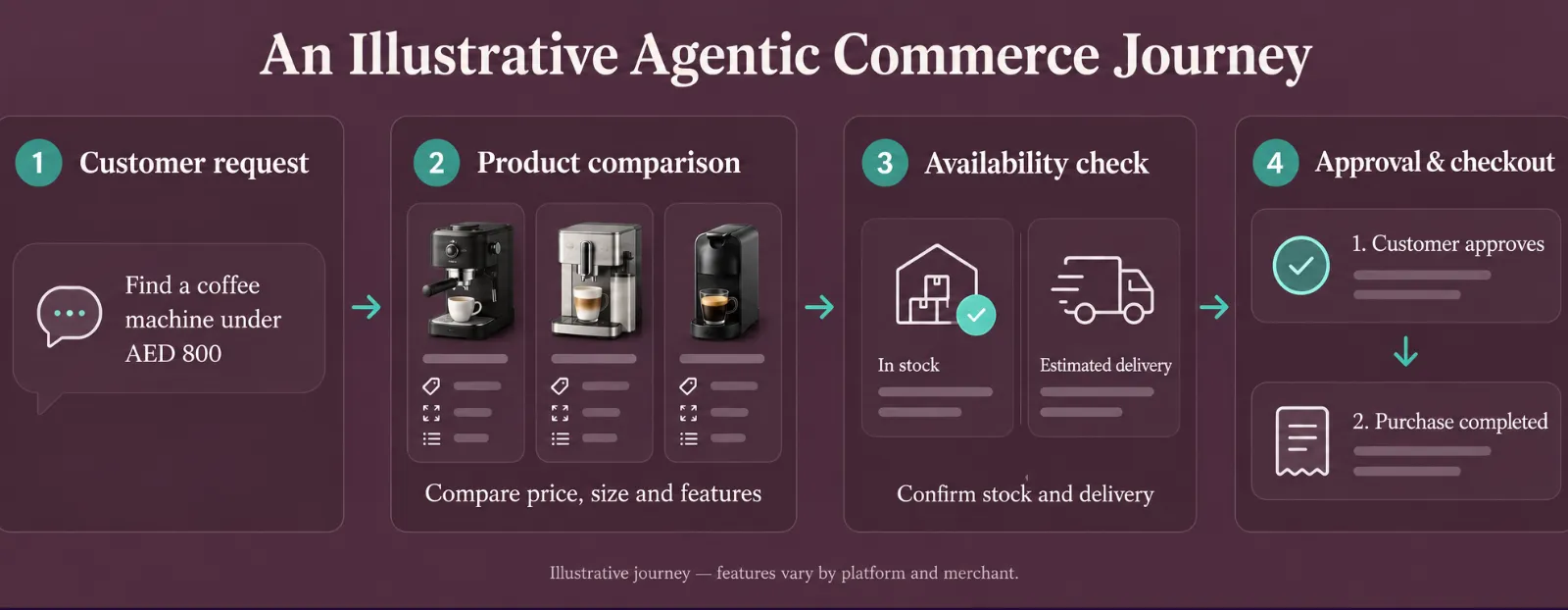
A Shorter Shopping Journey
The best part of conversational shopping is how much context fits into a single request.
“Before Saturday” makes the delivery part of product selection.
“Easy to maintain” makes maintenance as important as price.
Therefore, the e-commerce journey is less dependent on shoppers visiting several websites to assemble an answer. An AI shopping assistant may have already done some of those comparisons before a retailer receives the visit.
Adobe’s report published on 19 August 2026 found that, in July, AI-referred visitors to U.S. retail sites converted at a 60% higher rate than visitors from non-AI sources. They also added items to carts at a 28% higher rate. These figures describe referred website visits, not purchases completed autonomously by agents. They suggest that AI-assisted research can bring shoppers closer to a decision; they do not establish the same results for UAE retailers.
Checkout Is Still Evolving
Currently, agentic commerce is developing through different methods.
In September 2025, OpenAI introduced Instant Checkout and the Agentic Commerce Protocol, developed with Stripe, connecting conversations with supported purchases. By March 2026, OpenAI said the initial checkout experience lacked the flexibility it wanted. It shifted its focus to richer product discovery while allowing merchants to use their own checkout experiences.
This development is essential. AI checkout does not always mean buying inside a conversation. An assistant may lead discovery and hand the shopper over to a merchant’s checkout.
For businesses preparing for agentic commerce, useful content and functioning retail systems must work together. Copy can explain a product’s suitability; connected systems must confirm current prices, stock, and transaction details.
Permission Builds Confidence
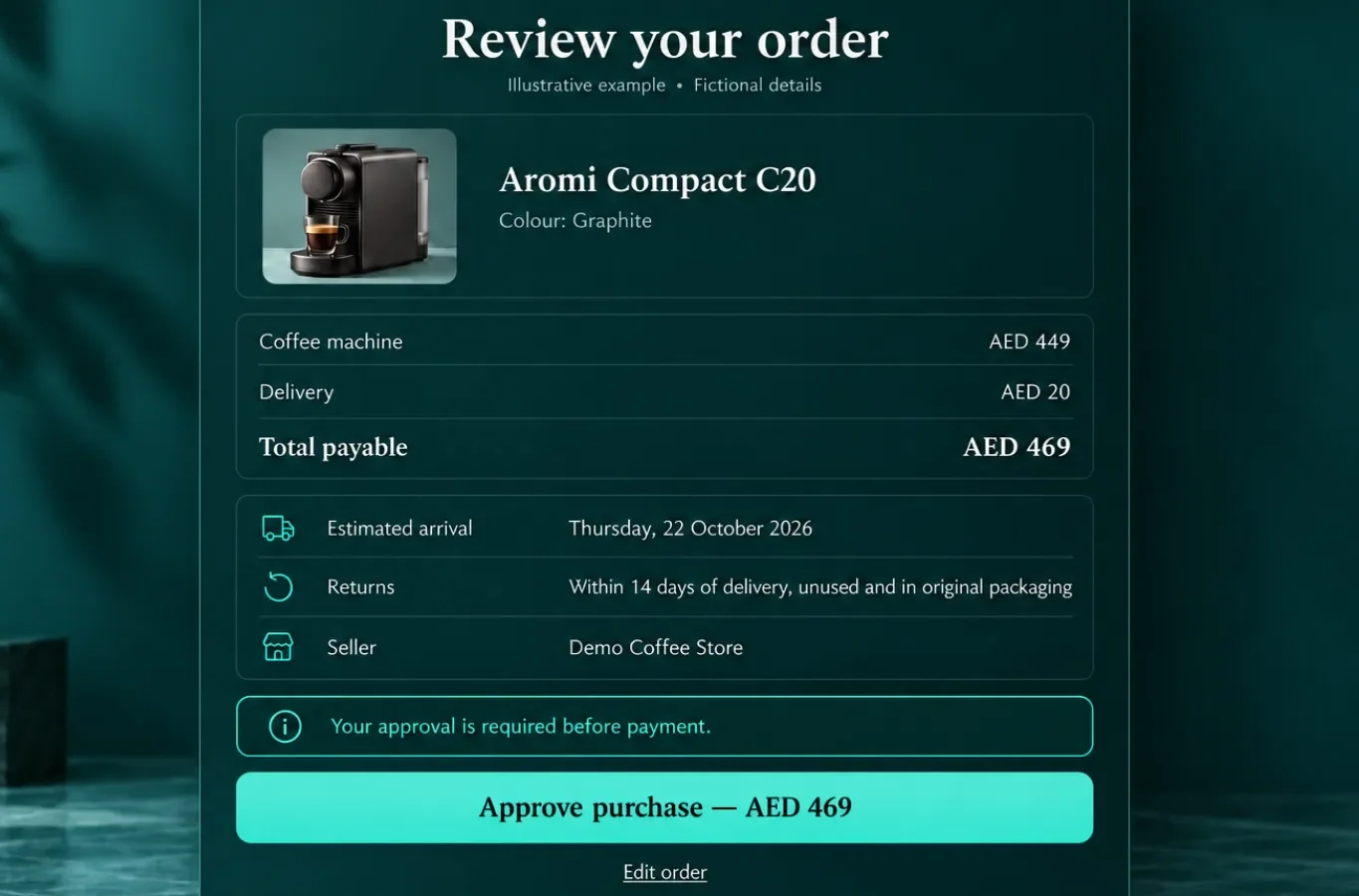
Consider our coffee-machine shopper. The assistant selects a suitable model, but delivery costs push above AED 500. Should it choose something cheaper, change the deadline, or ask? This reveals the human side of agentic commerce. Shopping feels easier when customers know what AI has checked and can approve key decisions.
Customers should be clear on who they are buying from, which product option they have chosen, total cost, expected delivery charges, and return policy. They should also know when to approve the purchase and where help is required.
Even a helpful AI conversation can lose their trust if they face surprise charges or receive something they never agreed to buy.
Start With the Basics
Agentic commerce has already begun taking shape in UAE retail. In February 2026, LuLu announced its launch of agentic commerce with Mastercard, bringing AI assistance to product discovery, personalised recommendations, and secure payments.
As agentic commerce begins to take shape in Dubai and across the UAE, businesses can start with a few practical improvements:
- Clarify product fit: Strengthen product detail pages with dimensions, compatibility, maintenance needs, and honest limitations.
- Keep live details consistent: Align prices, variants, and stock across your website and product feeds.
- Explain local requirements: Specify delivery areas, charges, cut-off times, and realistic arrival estimates.
- Check supported integrations: Ask your platform provider which discovery and transaction features are available for your market.
- Test the handover: Follow the journey from an AI referral through checkout, confirmation, and support.
My approach to SEO content writing and website copywriting at Suman Shafi starts by making business information useful to the person making the decision. That foundation remains valuable as shopping interfaces change.
The Decision Still Matters
Agentic commerce may reduce the effort between wanting something and ordering it. Businesses still need to earn the confidence behind that order.
The coffee-machine shopper wants a purchase that is perfect for their kitchen, reasonably priced, and easy to use. The strongest shopping experience respects all three, even when the quickest answer is to pause and ask.
For clear product content that supports AI-assisted shopping, explore my content writing services or connect through my Google Business Profile.
Connect With My Writing & Digital Platforms
📩 Explore My Content Writing Services
⭐ View My Google Business Profile
💼 Connect With Me on LinkedIn
✍️ More on Writing and SEO Insights
Frequently Asked Questions
How does agentic commerce differ from a chatbot?
A basic chatbot answers questions. An agent can also perform supported tasks through connected systems and agreed permissions.
Can AI complete every purchase?
No. Checkout support depends on the platform, merchant integration, product, and region.
Does agentic commerce replace SEO?
No. Discoverable, accurate product information remains useful, alongside reliable feeds and transaction systems.
Can small UAE businesses prepare?
Yes. Start with complete product information, consistent inventory, clear delivery terms, and supported platform features.
Who handles returns?
Check the specific service’s terms. In OpenAI’s original Instant Checkout model, the merchant handled fulfilment, returns, and support.