
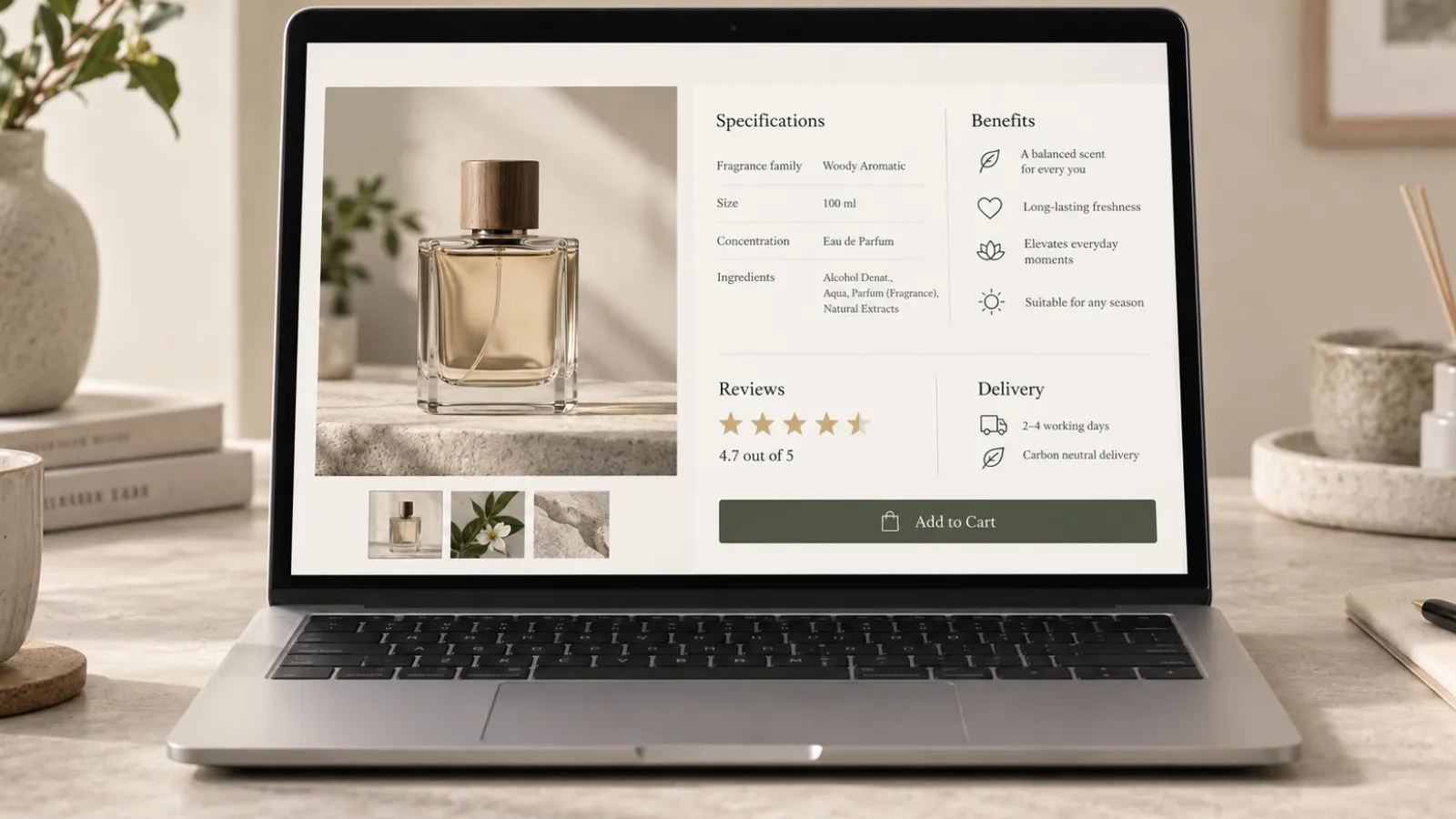
A shopper lands on your company’s product page, reads every specification, and still leaves without understanding one important thing: Is this right for me?
This is the gap many product detail pages fail to close. They describe the product accurately but never translate those details into meaning. A good page should help customers understand who the product is for, how it fits into their lives, and why they can trust it.
Specifications Are Not Answers
A central issue with many product detail pages is that they give information without helping people make sense of it.
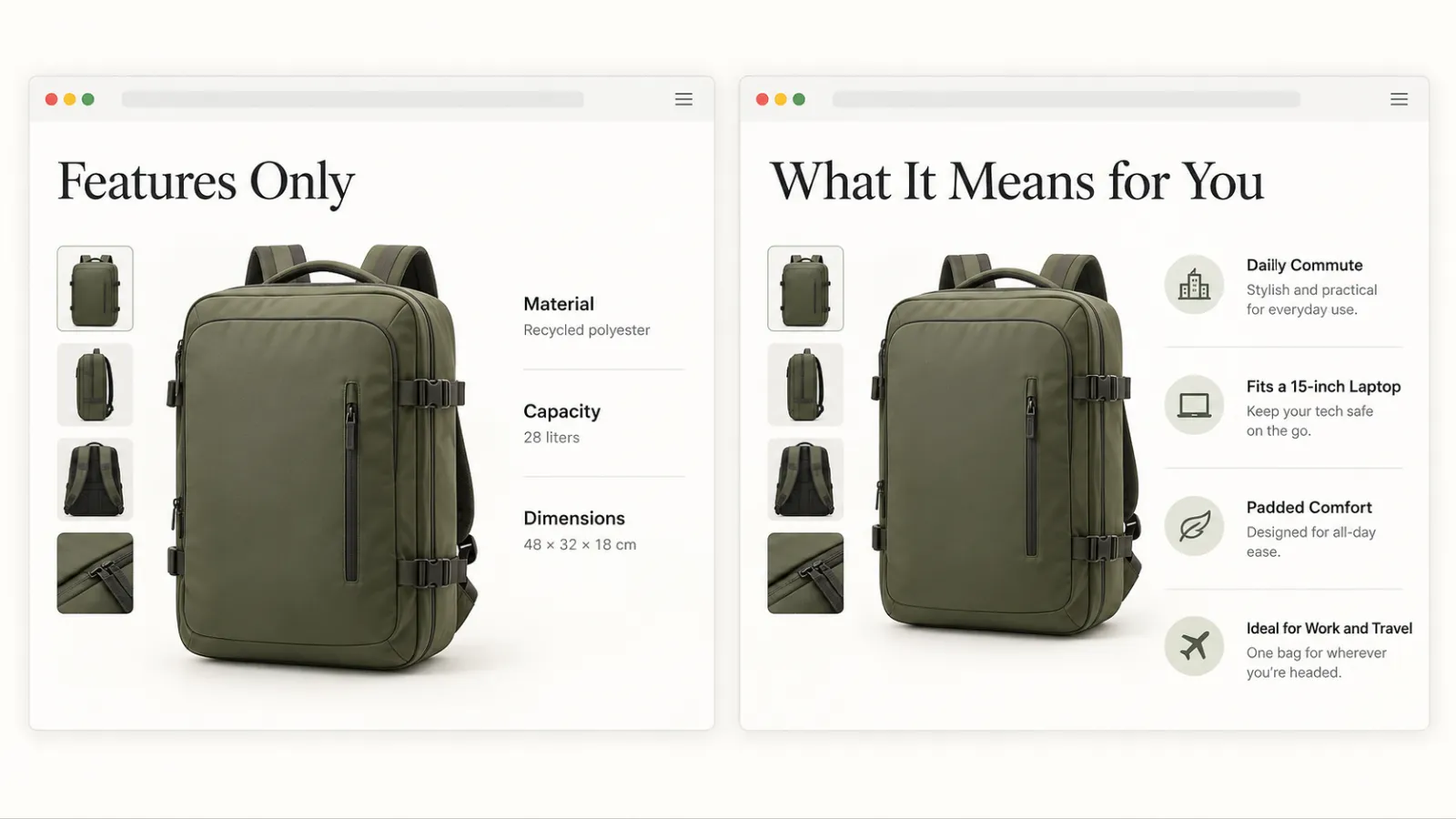
A list of features may inform a customer that a work bag has a 15-litre capacity, water-resistant fabric, and four internal compartments. It does not clarify whether the bag is comfortable for a daily commute, spacious enough to carry a laptop, or practical for someone traveling between meetings.
Specifications are important because customers compare technical details. But they alone don’t answer questions behind a purchase decision:
- Will this solve my problem?
- Is it suitable for someone like me?
- How is it different from similar alternatives?
- Is the quality worth trusting?
- What should I know before ordering?
If these answers are missing, the customer has to do the work. Many will easily move to another website where choice feels easier.
The Description Gap
A common fact across e-commerce websites is that pages start with polished adjectives, such as “innovative” or “high-performance.” These words create an impression, but no evidence to support it.
Baymard Institute’s product-page research found that only 48% of leading desktop e-commerce sites had “decent” or “good” product-page UX. The figure dropped to 38% for mobile sites. The usability testing also showed that shoppers sometimes abandoned suitable products because of avoidable problems on the page, not because the products themselves were unsuitable.
In businesses in Dubai and across the UAE, customers regularly compare local retailers, international marketplaces, and social-commerce options. If they find vague product descriptions, they cannot compare easily.
Effective product detail pages do not decorate features with more adjectives. They connect each feature to a practical situation.
Rather than saying “this perfume is suitable for men and women.
Try saying: This gender-neutral fragrance mixes fresh citrus and woody notes, making it a daily choice for anyone who prefers a clean, muted scent.
The feature exists, but now its value is clear.
Pages Now Serve AI Too
A product page is not written only for people who have seen your website.
Search engines, marketplaces, and AI tools may have already analyzed that information before the customer reached your website page.
Salesforce reported in 2025 that 39% of shoppers—and 54% of Gen Z shoppers—were already using AI for product discovery. Its research involved 8,350 shoppers and 1,700 retail decision-makers. Adobe Analytics also found that traffic from generative AI sources to US retail websites increased by 1,200% in February 2025 compared with July 2024. The research analysed more than one trillion visits to US retail websites.
This shows the importance of product page content. Clear and complete product information also supports more reliable AI product recommendations by helping AI understand the product’s specifications, use cases, and suitability. AI search is changing the way people shop and influencing which products customers discover and compare.
For ecommerce SEO, this means writing naturally around genuine customer questions rather than repeating generic keywords.

People Still Need Reassurance
Technology may help with discovery, but people still make the final emotional calculation: Do I trust this enough to buy it?”
Strong product detail pages resolve the hesitation by providing specific information. They explain who benefits from the product, show its realistic use, acknowledge limitations, and support claims with reviews or proof.
A product does not need to suit everyone.
Stating that a compact desk is ideal for apartments and small home offices, but may not suit a dual-monitor setup, can build more customer trust than presenting it as the perfect desk for every buyer. Staying honest also helps reduce unmet expectations after purchase.
Build a More Useful Page
Include the following elements to strengthen your product detail pages:
- Start with the customer’s need: Explain the situation or problem the product solves.
- Translate features into results: After every feature, answer: “What does this help the customer with?”
- Explain your ideal user: Add information about how the product fits into daily routine, environments, experience levels, or use cases.
- Include decision-making details: Mention dimensions, materials, care instructions, compatibility, delivery information, availability, and return terms.
- Use visual evidence: Include close-ups, scale references, demonstrations, and photographs showing the product in context.
- Answer real questions: Build FAQs around issues customers raise before purchasing, not questions created only to hold keywords.
- Keep information consistent: Product feeds, marketplace listings, social content and the website should not contradict one another.
This also connects with a wider shift in the e-commerce journey. Wherever discovery begins, customers should receive the same clear and dependable product story.
Clarity Helps People Choose
The best product detail pages don’t limit themselves to facts. They organize those facts around a decision.
A customer shouldn’t imagine why a specification matters or search elsewhere for basic reassurance. A page should silently answer the questions forming in their mind and help them decide with confidence.
Features help describe the product; the meaning explains why someone should care: this is the approach I bring to SEO content writing at Suman Shafi – making information useful to search systems without losing sight of the person reading it.
If you need help turning product features into clear, customer-focused content that supports visibility and sales, connect with me through my Google Business Profile or explore my SEO writing services.
Connect With My Writing & Digital Platforms
✍️ About Suman Shafi
✍️ Read More: Writing and SEO Insights
💼 Connect With Me on LinkedIn
⭐ View My Google Business Profile
📸 Follow @suman.reflects on Instagram
📩 Explore My Content Writing Services
Frequently Asked Questions
What is a product detail page?
A product detail page is a dedicated webpage containing the information customers need to understand, assess and purchase a specific product.
What should product detail pages include?
They should include benefits, specifications, use cases, images or videos, dimensions, pricing, availability, delivery details, reviews, return information and FAQs.
How do product detail pages support SEO?
Well-written product detail pages give search engines clear information about the product, the needs it addresses and the searches for which it may be relevant.
Should features be removed from a product page?
No. Features should remain, but important features should be connected to practical benefits so customers understand their value.
Can stronger product descriptions improve conversions?
Clearer descriptions can reduce uncertainty, communicate value and help customers determine whether a product is suitable, all of which can support the conversion rate.