

Have you opened an article, read a few lines, and immediately clicked away?
Most of us have.
This doesn’t happen because the topic seems uninteresting. Usually, this kind of writing feels difficult to follow, repetitive, or simply generic. Within a few seconds, readers make up their minds whether an article deserves their attention. And if it doesn’t hook them, they move on.
Understanding why readers leave articles quickly has become essential in 2026. People have countless ways to find information. There are Google, AI assistants, short videos, and social media to browse. Every piece of content not only competes with other websites but also with an entire digital ecosystem.
For businesses in Dubai and across the UAE, this means writing is no longer limited to filling a website. Google itself continues to emphasize creating helpful, honest, reliable, people-first content that genuinely satisfies readers rather than content written primarily for rankings.
The First Impression Happens in Seconds
I have noticed while reviewing websites that many articles start with long introductions that delay the real answer. What needs to be understood is that readers don’t browse a website to read big paragraphs. They are impatient and want their answers quickly and with clarity.
Why readers leave articles quickly?
- They often find paragraphs explaining why the topic matters before actually discussing the topic.
- Their reading experience feels slower than it needs to be. The longer readers wait to receive value, the more likely they are to leave.
Simple openings, neat structure, and immediate relevance make readers feel they are in the right place.
If you’ve already read my article on Google Ranking Content in 2026, you’ll know that search engines highly reward content that satisfies user intent, not content that simply contains keywords.
Search Behavior Has Changed
With the increased progress of AI, the way people consume information has changed.
Rather than reading an article from start to end, users often compare summaries, scan headings, and jump directly to sections that answer their questions.
Long-form content exists, but every paragraph has to earn the reader’s attention. Recent SEO search indicates that successful content in 2025 places greater emphasis on research, user intent, and readability than on simply producing more articles. This reflects a broader shift towards quality and usefulness in search results.
In other words, people aren’t reading less. They are becoming more selective.
Make Every Word Count
Today, readers leave articles quickly because many articles are technically well-written, but leave little impression. They repeat ideas readers have come across many times, use jargon where simple language would work better, and they could have been written for anyone.
In a world where content is everywhere, people don’t remember the articles that sound the smartest. They remember the ones that sound genuine, explain things clearly, and make them feel understood.
This is one of the reasons why avoiding keyword stuffing is so important. When content is written with clarity instead of unnecessary repetition, it becomes much easier to read and understand. Using keywords naturally, reducing mental effort, helps readers stay engaged and encourages them to keep reading.
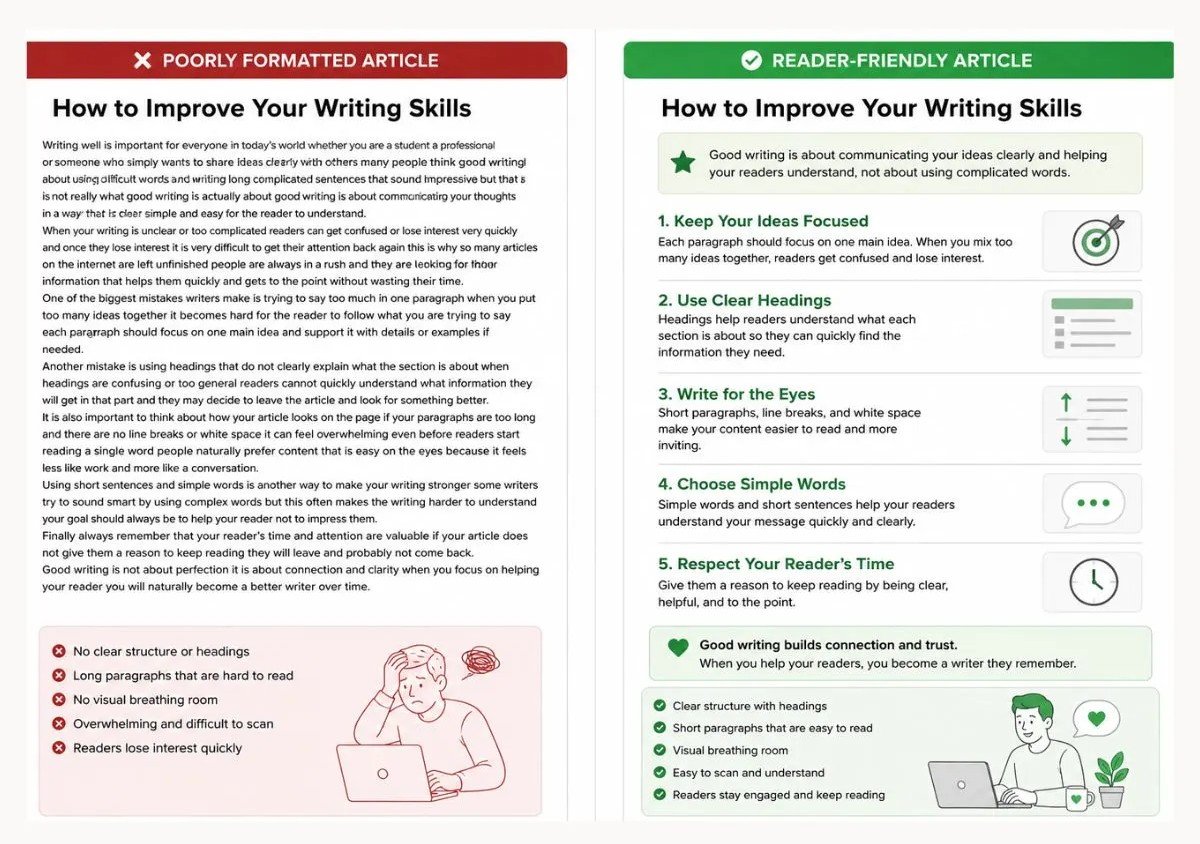
7 Simple Writing Fixes
To understand why readers leave articles quickly, you don’t need to use complicated language or techniques to keep readers hooked on your content. A few simple habits go a long way:
- Start with a question, observation, or problem that readers recognize.
- Make sure paragraphs are short enough to understand and scan.
- Consider meaningful headings.
- Remove repetition.
- Add real examples instead of generic advice.
- Answer the reader’s question before promoting your business.
- End with a clear takeaway.
These changes improve user experience and SEO because readers stay on the page longer and find the information they came for.
Google’s people-first content guidance consistently encourages creators to focus on usefulness, originality, and reader satisfaction instead of writing primarily for search engines.
Good Writing Builds Trust
Businesses usually assume that every article should immediately promote a product or service.
But for readers, trust always comes before a sale. When they finish an article feeling that it genuinely answered their questions or helped them solve a problem, they’re more likely to explore the writer, the business, or the services behind the content. Rather than feeling like they’ve been sold to, they feel they’ve found a source they can rely on. That’s why thoughtful, reader-focused content continues to deliver better long-term results than publishing articles simply to maintain a consistent posting schedule.
If you’re investing in SEO blog writing or website copywriting, every article should leave readers feeling they learned something useful, not that they read another advertisement.
This is exactly why I often recommend businesses invest in strategic SEO content writing instead of publishing generic AI-generated articles.

Every Reader Is Giving You Something Valuable
Attention has become one of the most valuable resources on the internet. Every visitor who lands on your article is choosing to spend a few moments of their day with your content. The real question isn’t whether your article is long enough, but whether each paragraph gives readers a reason to keep going. That is the difference between content that gets abandoned and content that gets remembered.
Why readers leave articles quickly comes down to the experience you create. People aren’t simply looking for more information; they’re looking for content that is clear, useful, and worth their time.
As Suman Shafi, I believe the most effective content isn’t the content that says the most. It’s the content that respects the reader’s time, answers their questions clearly, and leaves them feeling they made the right decision by staying.
If you’re looking for SEO content writing or website copywriting that helps readers stay engaged, explore my Content Writing Services page or connect through my Google Business Profile to learn more about my work with businesses across Dubai and the UAE.
Connect With My Writing & Digital Platforms
✍️ About Suman Shafi
🌐 Official Website
📩 Content Writing Services
⭐ Google Business Profile
💼 LinkedIn
📸 Instagram (suman.reflects)
✍️ Writing and SEO Insights
Frequently Asked Questions
Why do readers leave articles quickly?
Readers usually leave because the article is difficult to scan, lacks a clear structure, delays the main point, or doesn’t immediately answer their question.
Does readability affect SEO?
Yes. Clear, well-structured content improves user engagement, which supports better search performance alongside other SEO factors.
How can I make readers stay longer on my blog?
Use compelling introductions, short paragraphs, descriptive headings, practical examples, and answer search intent early in the article.
Does AI-generated content increase bounce rates?
Not necessarily. AI-generated content can perform well if it’s edited, original, accurate, and genuinely helpful. Generic, repetitive content is what readers tend to abandon.
Is long-form content still effective in 2026?
Yes. Long-form articles continue to perform well when they’re valuable, easy to read, and written around the reader’s intent rather than word count.