
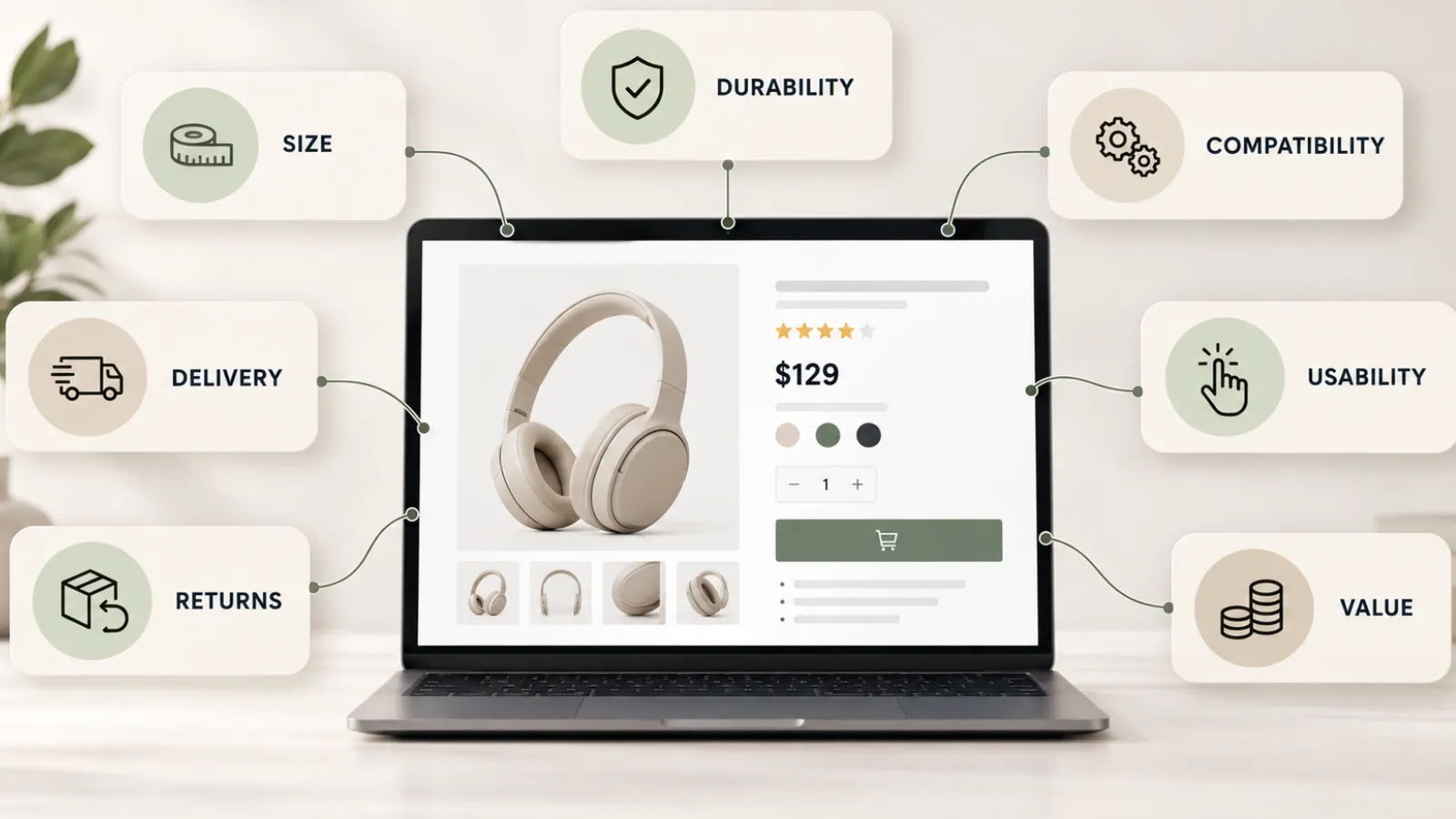
A customer may love your product and accept the price but still leave without buying. The issue isn’t always a weak product or a better option elsewhere. Sometimes, one unresolved concern can make the purchase feel too risky.
Addressing customer pain points directly can turn hesitation into a confident decision.
Find the Real Objection
Businesses often describe products based on what they sell.
Customers assess them based on what could go wrong.
- A shopper searching for a work chair may wonder whether it provides good back support, is adjustable, and is comfortable during long working hours.
- Someone looking for wireless headphones may be concerned about device compatibility, battery life, or call quality.
These are not general requests for more information. They are specific purchase concerns that product copy should resolve.
Firstly, identify the questions customers ask before purchasing. Read customer service emails, product reviews, live-chat conversations, search queries, and return reasons. They reveal customer pain points that matter more accurately than assumptions made during a content meeting.
Search Has Become More Specific
People now use search based on their situation rather than searching a basic product name.
Instead of searching for “office chair,” someone may search for “adjustable office chair that supports lower-back pain.” A customer may ask an AI assistant to find headphones that connect to three devices and work well for video calls.
This reflects the wider e-commerce customer journey, where product discovery may begin through search, social media, or an AI assistant before the customer reaches the product page. Wherever that journey begins, the product page must resolve the concerns that influence the final decision.
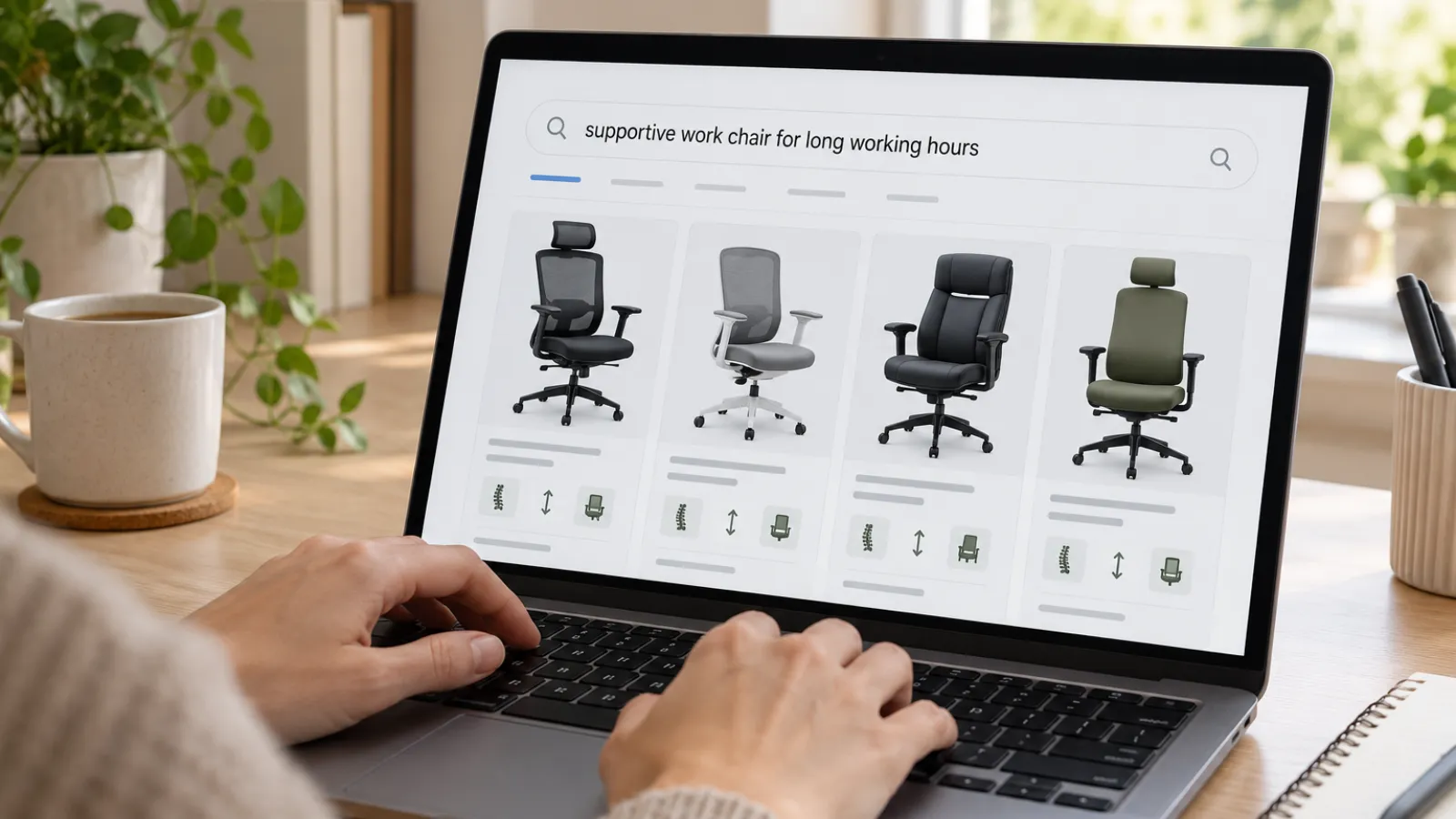
This changes what useful product content looks like. Search engines and AI tools need clear answers connected to specific situations. Businesses should write about genuine concerns without adding unrelated phrases to use more keywords.
As e-commerce search intent is becoming more detailed and problem-based, it also gives businesses a practical opportunity to address customer pain points naturally through their product copy.
1. Remove Doubts About Size and Fit
Measurements that lack context can still leave customers doubtful. Along with dimensions, explain how the product fits into a familiar setting or situation.
- For furniture, provide seat height, total width, weight, and recommended user height.
- For clothing, include garment measurements, model details, and whether the fit is relaxed or close.
Images showing scale can also prevent customers from forming the wrong expectation.
Don’t rely only on labels such as small, medium, or compact. These words mean different things across brands.
2. Explain Durability Honestly
A business cannot evaluate “strong, premium, and built to last” without supporting evidence.
Addressing customer pain points about the product’s stability can include:
- Naming the materials.
- Under what conditions they can be used.
- Frequency of care to be taken.
- Warranty period.
If a chair is intended for eight hours of daily use, mention it.
If a bag is water-resistant but not waterproof, explain the difference clearly.
Honest limitations can strengthen customer trust because they help buyers understand how the product should and shouldn’t be used.
3. Clarify Compatibility
Compatibility issues are frustrating because customers may find them only after delivery.
Product pages should name the devices, operating systems, accessories, dimensions, or connections a product supports. They should also highlight any known exclusions. Instead of writing “works with most smartphones,” list the supported systems or models. If an adapter is required, mention whether it is included or not.
Clear compatibility details address customer pain points while reducing avoidable questions and returns.
4. Make Delivery Predictable
Delivery information should answer more than whether shipping is available. Customers want to know the expected arrival date, delivery fee, service area, and whether bulky items require assembly or scheduled delivery.
For businesses serving Dubai and the wider UAE, information should also explain whether timelines differ between emirates or remote locations.
Show these details near the purchasing area instead of revealing them only after a customer begins checkout. Predictability makes the decision feel safer.
5. Simplify Returns
A return policy may exist, but that does not mean customers understand it.
The US National Retail Federation estimated that 19.3% of online sales would be returned in 2025. Its research also found that 82% of consumers considered free returns important when shopping online.
Make sure to resolve return-related customer pain points:
- Mention the return window.
- Accepted condition.
- Process for collection or drop-off.
- Refund method.
- Expected processing time.
The goal is not to promise free returns in every situation. It is to ensure that customers are familiar with the terms and conditions.
6. Show How the Product Works
A product could be useful but still feel difficult to assemble, operate, clean, or maintain.
Use:
- Short instructions.
- Demonstration videos.
- Labeled images or a simple “how it works.”
- Mention what arrives in the box and whether installation requires additional tools or professional support.
Good product usability information prepares customers for ownership. It addresses customer pain points that may otherwise appear after the sale.
7. Explain the Value
Customers do not always choose the reasonable option. They look for product value that they can understand.
- Explain what is included in the price.
- How often the product may need replacement and whether it saves time, space, or future expense. For instance, a higher-priced work chair may include adjustable support, a longer warranty, and replaceable parts.
Avoid calling an item “great value” without an explanation. When a claim is supported by specific evidence, customers can decide better if the product is worth paying for.

Make Every Answer Easy to Find
When businesses address customer pain points, they do not need to create one long block of copy. They need to place each answer where the concern naturally appears. Add sizing beside product options, compatibility near each specification, delivery close to the purchase button, and a short returns brief within easy reach.
It is useful to understand why product detail pages need more than features. This article shows how a customer’s concern can be resolved practically.
The strongest product page respects and works on overcoming a customer’s doubt. It doesn’t rush the decision or hide inconvenient details. It quietly answers, “What would I need to know before spending my money?”
That is the approach Suman Shafi brings to SEO and website copywriting: helping businesses communicate clearly while keeping the reader’s real decision at the center.
Need clearer product or website copy that answers real customer questions? Explore my writing and content services, connect with me on LinkedIn or view Suman Shafi on Google.
Connect With My Writing & Digital Platforms
⭐ View My Google Business Profile
✍️ Read More: Writing and SEO Insights
✍️ About Suman Shafi
💼 Connect With Me on LinkedIn
📩 Explore My Content Writing Services
Frequently Asked Questions
What are customer pain points?
Customer pain points are specific concerns, difficulties or uncertainties that affect a person’s decision to purchase or use a product.
How can businesses identify customer pain points?
Review customer emails, support chats, search terms, product reviews, frequently asked questions and return reasons. Repeated concerns show where product content needs improvement.
Where should pain-point information appear?
Place information near the relevant decision. For example, show sizing beside product options, delivery details near the purchase button and compatibility within the specifications.
Can addressing pain points reduce product returns?
Clearer sizing, compatibility, usability and product-condition information can help customers choose more accurately and avoid preventable mismatches.
Should every product page cover the same pain points?
No. The concerns should reflect the product. Clothing may require detailed fit guidance, while electronics need stronger compatibility and setup information.